Access to information is the right of the public to obtain information held by public bodies as well as an obligation for governments to ensure records are created, maintained, and made readily available. Access to information is essential for informed public discourse on which democracy depends. It not only facilitates developing effective solutions to societal problems but also empowers communities that have historically been marginalized and silenced.

Court Submission June 10, 2026

Government of Saskatchewan as Represented by the Minister of Education v. UR Pride Centre for Sexuality and Gender Diversity, SCC Court File No. 41979

CFE Intervener Factum in the Supreme Court of Canada – UR Pride challenged the constitutionality of a Saskatchewan policy that parental consent was required if students under the age of 16 requested that schools use preferred first names and pronouns. In response, Saskatchewan amended its Education Act, incorporating the policy into law and invoked the Charter’s notwithstanding clause (s. 33). UR Pride sought a declaration that the legislation is unconstitutional. Saskatchewan argued that once it incorporated s. 33, the issue of constitutionality is moot and the court cannot issue a declaratory judgment. In its factum CFE makes three submissions. First, s. 33 should be interpreted in light of the public’s right to be informed in a democracy. Second, the public’s right to be informed pre-dates the Charter and is a throughline in the Supreme Court’s interpretation of Charter provisions, most notably ss. 2(b), 3 and 4. Third, because the invocation of the notwithstanding clause has to be renewed every five years, meaning there will be an election that allows the public to defeat a government if it objects to the government’s use of s. 33, judicial declarations are necessary information if the public is to be an effective check against misuse of s. 33.
News May 14, 2025

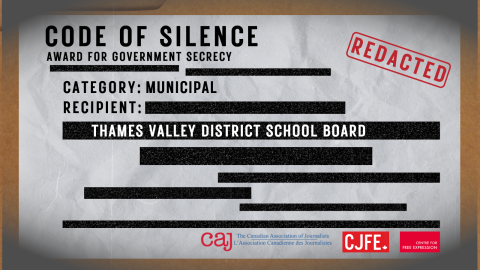
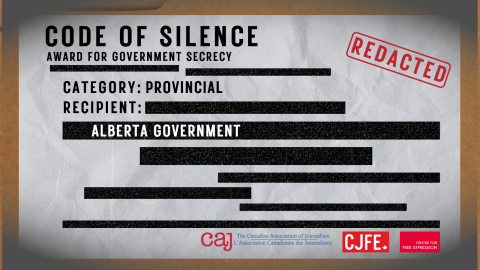
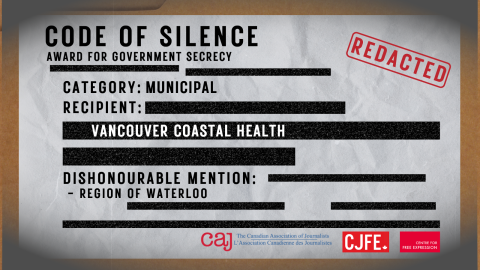
Vancouver Coastal Health receives the municipal Code of Silence Award for Outstanding Achievement in Government Secrecy for restricting information during the COVID-19 pandemic

Vancouver Coastal Health (VCH), the public agency responsible for delivering community and acute care services to more than a quarter of B.C.’s population, has been selected as the 2024 recipient of the municipal Code of Silence Award for Outstanding Achievement in Government Secrecy for its routine breaking of access to information laws during the COVID-19 pandemic. 
News April 16, 2025

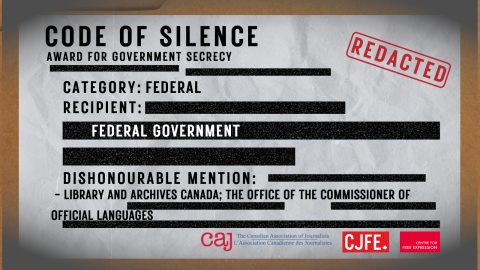
Federal government given the Code of Silence Award for its obstructing release of records about residential schools

Nearly ten years after the publication of the Truth and Reconciliation Commission (TRC)’s final report, Canada’s federal government continues to fight Indigenous groups from across the country seeking access to records surrounding residential schools. For this continued denial of access, it has been resoundingly selected as this year’s recipient of the federal Code of Silence Award for Outstanding Achievement in Government Secrecy.
News June 10, 2024

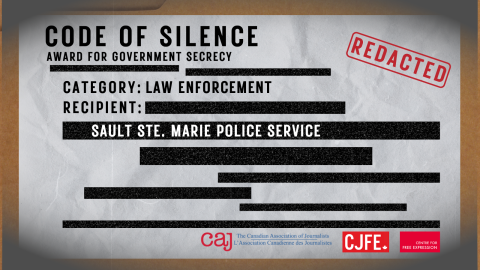
Vancouver Fire Rescue Services' chill on access to information recognized with Code of Silence Award for Outstanding Achievement in Government Secrecy

The Vancouver Fire Rescue Services (VFRS) has been selected as this year's recipient of the Code of Silence Award for Outstanding Achievement in Government Secrecy in the municipal category for its efforts to charge exorbitantly high fees for access to a fire investigation report already paid for by taxpayers.