While We Watch the U.S., Canada’s Democracy Is Quietly Eroding

With the precipitous decline of democracy in the United States, it is all too easy to ignore that Canada’s democracy is in decline as well. We ignore the signs at our peril.
Authoritative evidence of Canada’s democratic decline was provided in the recent annual report on the state of democracy globally issued by V-Dem Institute, a major independent research centre based at the University of Gothenburg in Sweden. V-Dem’s annual reports on democracy are based on its world-leading database with over 32 million data points for 179 countries and territories, involving over 4,200 scholars and other country experts.
Its Democracy Report 2026 is ominously subtitled, “Unraveling The Democratic Era?” The report notes that global advances in democracy have been rolled back to the levels of 1978, with “the level of democracy for the average citizen in Western Europe and North America at its lowest in over 50 years, primarily due to ongoing autocratization in the USA.” The report claims that 74% of the world population (6 billion) now live in autocracies, and only 7% (0.6 billion) live in liberal democracies.
Although the report focuses significantly on what has been happening in the United States, I was struck by its findings for Canada and the change in our country’s ratings over the past ten years on V-Dem’s five indices of democracy.
On all five, Canada has fallen notably since 2017 (See Table 1).
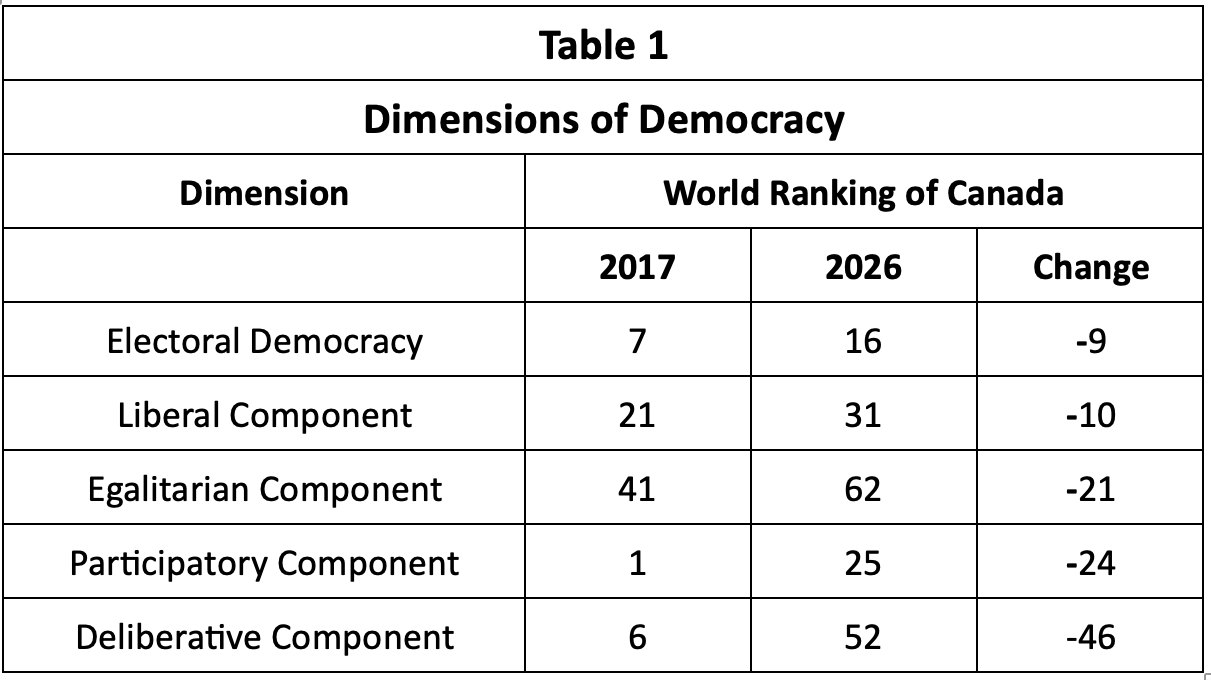
We fell the least on “electoral democracy,“ which for V-Dem measures the extent to which political leaders are selected through competitive, inclusive, and free elections; autonomy for civil society, parties, and unions; and the breadth of the adult population with legal and effective voting rights. That said, over the past ten years, we fell from 7th to 16th in the world.
On the “participatory component”, for which we were the best in the world in 2017, we fell to 25th. That component captures the extent to which citizens actively participate in political processes, both electoral and non-electoral. It emphasizes engagement beyond voting, focusing on direct democracy, civil society involvement, and subnational governance. We now trail not only most major European countries and the UK but also Romania, Moldova, Ecuador, Zambia, and Bolivia.
We were not so highly placed on the “liberal component” in the V-Dem 2017 Report, at 21st. The Liberal Component measures the extent to which a country’s government respects civil liberties, the rule of law, and institutional checks and balances on the executive. We have fallen another ten places since then, placing 31st. That puts us behind most of Europe but also Taiwan, Brazil, South Korea, Japan, and Mauritius.
The egalitarian component measures the extent to which all citizens and social groups enjoy equal participation, representation, legal protection, and influence over policymaking, and is grounded in the principle that material and immaterial inequalities inhibit the full exercise of political rights and liberties. In 2017, we were embarrassingly ranked at 41st, but in the following ten years we fell to 61st, trailing most of Europe, the UK, but many others such as Tanzania, Bulgaria, Armenia, Moldova, Bhutan, Lesotho.
Finally, we must note what is happening with the deliberative component, which measures various attributes considered to be the heart of democracy. These include the extent to which leaders provide public, evidence-based rationales for policies; the degree to which decisions are oriented toward societal well-being; citizens’ willingness to acknowledge and engage with opposing views; the success at integrating diverse societal groups into policy discussions; and the extent to which deliberation involves grassroots or independent organization. On these all-important measures, Canada has fallen from 6th in the world to 52nd in the past ten years.
The question is, why is this happening? Why is Canada‘s standing declining markedly on so many important registers of the success of a democracy?
First, the various structures and traditions of Canadian governance put our democratic ideals at risk. In general, Westminster parliamentary democracies give enormous executive authority to the prime minister – something Trump covets for the US presidency. Because this poses a threat to democratic governance, our counterparts have more guardrails than Canada does.
As Donald J. Savoie has written in Governing from the Centre: The Concentration of Power in Canadian Politics: “The prime minister alone…has access to virtually every lever of power in the federal government, and when he puts his mind to it he can get his way on almost any issue… .” But the prime minister is also permitted single-handedly to do so much: they not only get to “articulate the government’s strategic direction as outlined in the Speech from the Throne” but to determine every aspect of implementation, with both domestic and foreign policy matters, have a hand in establishing the government’s fiscal framework; represent Canada abroad; establish the mandate of individual ministers and decide all machinery of government issues, and serve as “the final arbiter of interdepartmental conflicts.” All of this decision-making authority “in the hands of one individual . . . constitute[s]. a veritable juggernaut of power.”
If anything, the patterns noted by Savoie have only increased in the past two decades. Governance by Cabinet is more a fiction than a reality – being increasingly supplanted by governance directives from the Prime Minister’s Office (PMO), starting with the prime minister’s ministerial mandate letters and then continuing directions to ministers from the PMO. In his memoir, Marc Garneau wrote that during his time as Canada’s foreign affairs minister, he was called upon only once to advise the prime minister. After resigning in 2020, Finance Minister Bill Morneau wrote that decision-making had become increasingly centralized in the Prime Minister's Office. In an interview with the Harvard International Review, he elaborated:
Broadly, I do believe that there has been a greater level of centralization in Canadian politics over the last couple of governments. That means by definition [there is] less authority for ministers, which results in policies that have not taken into account the full range of considerations.
Members of parliament (MPs), who are not in Cabinet, have very little democratic power at all. Theoretically, their votes determine what Canada does. But, as various commentators have noted, while formally true, MPs actually have little say. Their opportunity to speak in Parliament or to bring private members’ bills is governed by their leader’s office. Except for the very rare “free votes”, their voting on every bill is “whipped”, i.e., where the party leadership requires all its members of parliament (MPs) to vote strictly along party lines. If an MP defies the party's official stance, they risk internal disciplinary action, such as losing committee assignments or being expelled from the party caucus. A report by the Samara Centre for Democracy revealed that Canadian members of parliament vote with their own party 99.6% of the time, indicating an "extreme" level of party loyalty compared to the British Parliament.
In his recent book, The Crisis of Canadian Democracy, veteran journalist Andrew Coyne writes:
A Canadian Member of Parliament…would seem a curious sort of representative. Their job is not to represent their constituents, but to represent the party; to vote as they are told, to speak the lines they are given, to applaud on cue.
MPs’ other role is to sit on parliamentary committees. But the reality of Canadian parliamentary committees is a far cry from that of British parliamentary or U.S. congressional committees which have the power to launch investigations and to compel testimony. In Canada, their role is to examine bills in detail, oversee government operations, review department spending, and conduct studies. But at the end of the day, they have no authority. Recommendations of committees can and often are disregarded if they diverge from what the government wants to do. This happens to unanimous committee recommendations.
Even the ability of a committee to have meaningful consideration of a bill can be stymied by the government. In a majority situation, the government can introduce a motion setting strict limits on how many days or hours a committee has to consider and report back on a bill. If the committee fails to meet this deadline, the bill is "deemed reported back" without further amendments. In the House of Commons, the government can table aggressive programming or specialized timetabling motions that strictly limit clause-by-clause review and restrict MPs from introducing new amendments. The government majority within a committee can pass procedural motions to limit debate. Committees regularly adopt motions that restrict the number of witnesses, cap speaking times (usually to 5 or 10 minutes per intervention), or terminate clause-by-clause study at a specific date.
To add to the challenges of committees being places for meaningful study of a bill, Canadian governments have increasingly turned to omnibus bills that mash together a variety of issues and proposals in a bill that can be hundreds of pages long. Each part would require as much time as the committee is given for all parts, thereby ensuring little serious study of any part of the bill and little or no opportunity to consider and improve the bill.
The centralization of power makes possible the undermining of democracy since so much of democratic practice is based on norms. It is hardly surprising that Canada’s version of parliamentary government, which is amenable to extreme centralization of power, becomes especially vulnerable to undemocratic executive overreach.
The V-Dem 2026 Report captures data to the end of 2024 and into 2025. It appears that the decline of democracy in Canada is accelerating under Prime Minister Carney’s current regime. This is perhaps best exemplified by his government’s firehose of bills undermining basic civil liberties, human rights and democratic practices. These have been rushed through Parliament without opportunity for serious consultation, study, discussion, and thorough debate -- exploiting flaws in Canada’s democratic structures and practices.
An early example was Bill C-5, the One Canadian Economy Act, which was rushed through parliament in days, with no meaningful time for public consultation and with the barest pretence of “study” by House and Senate committees—all despite its extraordinary provisions granting sweeping and potentially unconstitutional powers to the federal Cabinet over projects deemed in the national interest. This bill permits such projects to bypass environmental laws and legal safeguards and to proceed without the free, prior and informed consent of Indigenous Peoples whose lands and communities would be affected.
In Bill C-4, Making Life More Affordable for Canadians Act, the Government buried an unrelated provision in the bill -- to exempt federal political parties from complying with provincial privacy legislation – making it effectively impossible to deal with this proposal that had no relation to the rest of the bill.
The Government used the same tactic in its attempt to pass an undemocratic proposal giving any Cabinet minister the unilateral right to exempt any individual, corporation, partnership, unincorporated association or organization as well as Canada or a province, for a period of up to three years, “on any terms that the minister considers appropriate,” from the provisions of any Act of Parliament, except the Criminal Code. The only limit on this extraordinary individual power was the minister had to have responsibility for the Act being overridden and the minister had to be of the opinion that the exemption was in the public interest. This unprecedented provision was buried on pages 300-302 of the 604 page Bill C-15, Budget 2025 Implementation Act. There was so much outrage when this was discovered that public pressure forced the Government to water down the granting of such powers to a single minister by specifying laws beyond the Criminal Code that the minister could not grant power to override, and to require that the minister’s action would have to be preceded by a 30-day public consultation and require approval by the President of the Treasury Board.
Bill C-12, with its Orwellian name “Strengthening Canada's Immigration System and Borders Act”, moved Canada’s treatment of refugees and immigrants closer to that of the Trump administration. Despite massive opposition, the government fast-tracked it through Parliament by accelerating its scheduling, limiting debate, and restricting the number of civil society organizations allowed to testify before committee.
Bill C-14, Bail and Sentencing Reform Act, which moves our criminal justice practices closer to those in the U.S., was also fast-tracked through the House of Commons Justice Committee, precluding proper time for careful study and adequate consultation with criminal justice and legal professionals or for heeding the warnings by the Canadian Civil Liberties Association (CCLA) and others that the accelerated process made possible by the bill would have a serious and disproportionate impact on vulnerable and marginalized communities in Canada.
Bill C-9, the very controversial Combatting Hate Act, has been moved through Parliament at even greater speed. The government utilized time allocation motions to expedite its passage, which capped remaining debates on Senate amendments to just five hours before forcing a final vote. The Bill criminalizes the already illegal act of hindering access to a place of worship and also criminalizes peaceful protest that provokes “a state of fear” – a subjective and ill-defined concept likely to have a chilling effect on constitutionally protected expression and protest.
Bill C-22, Lawful Access Act, which is currently in the final stage of its too-swift passage through parliament, is perhaps the most serious assault on Canadians’ privacy rights in history. The Government’s rush to impose the law has brought together a wide range of groups in opposition -- from major civil liberties organizations to the Canadian Chamber of Commerce, the Canadian Bar Association, the Barreau du Québec, and providers of critical security tools like Nord VPN, the Tor Project, and the Signal messaging application. C-22 will allow the government to force companies to create backdoors into their data systems so police and spy agencies can scoop up Canadians’ personal data and communications, making online protections like encryption meaningless; allow the government to order companies to hold on to Canadians’ personal information for up to a year, creating a treasure trove of data that could serve as a digital map of everyone in Canada and which could be misused, leaked, or targeted by hackers; and allow government to more easily share Canadians’ information with US intelligence and law enforcement agencies, including for their investigation of acts that are legal in Canada.
Democracy is a process – it is always becoming stronger or weaker depending on what we do and allow or don’t allow. As Nobel Peace Laureate Maria Ressa famously said, “Democracy is fragile. You have to fight for every bit, every law, every safeguard, every institution, every story." It is time we take her words seriously and recognize that we individually and collectively are custodians of our democracy. We can continue to allow it to erode, as V-Dem makes clear has been gradually happening in Canada, or we can follow Ressa’s advice to fight for every bit that sustains and promotes our individual and collective democratic rights. No one can do this for us.