Misinformation alert: reducing corruption improves productivity and well-being, not the reverse

In a recent opinion piece in the Toronto Star, staff journalist Justin Ling argues that to improve productivity, Canada needs to tolerate more corruption. This is nonsense – in fact the reverse is true. As he says, simply creating more bureaucracy in response to each scandal doesn’t work. But it is also crystal clear that tackling corruption properly leads to improved productivity (GPP per capita) as well as greater well-being. The Transparency International (TI) Corruption Perceptions Index demonstrates this: the countries with the least corruption are also the wealthiest and happiest, while those with the worst corruption are also the poorest and most miserable. We should be emulating the countries that outrank us on this index – but sadly we are not.
The reality is that Canada has a problem of growing corruption, as our steep decline in the TI index suggests, and this decline is inevitable due to our ongoing failure to tackle the issue. We have a system of rules that may look good on paper, but are largely for show: they are not adequate and are not enforced. Consequently, we have organized crime well established in all of our major cities, a banking system that is a hub for international money laundering, and bureaucracies that sometimes act like charities for crooks.
A seemingly endless sequence of preventable scandals also casts doubt on the integrity and competence of our governments: the SNC-Lavalin fiasco, the $60 million ArriveCan procurement boondoggle, the $2 billion Lac Megantic rail disaster, the $5 billion dollar Phoenix Pay system fiasco, the Ford government’s $8 billion greenbelt land swap. The list goes on…
Perhaps the most notable aspect of all these scandals is the lack of accountability: those most responsible have suffered no consequences – so they remain in power and free to cause more damage, and the root causes of these failures are not acknowledged or addressed.
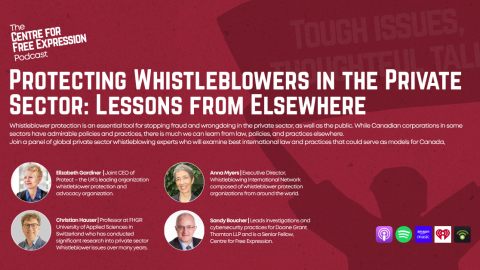
TI has observed that Canada’s anti-corruption mechanisms are riddled with holes – but one omission stands out: the almost complete lack of protection for witnesses to wrongdoing who come forward, often at great risk to themselves – whistleblowers.
How does corruption within organizations usually get exposed? The public tends to think of auditors or perhaps law enforcement as key players, but decades of research show otherwise. By far the most effective mechanism for exposing wrongdoing is tips from whistleblowers, both internal and external, accounting for more than 40% of all exposures. In fact, tips are roughly three times more effective at exposing wrongdoing than internal audits, 10 times more effective than external audits, and 20 times more effective than law enforcement.
Protecting whistleblowers is essential to protect the public, the integrity of our institutions and our democracy, which is why more than 60 countries have national whistleblower protection laws as part of their anti-corruption systems, including all EU members. Yet Canada has virtually no protection for our whistleblowers, who typically suffer career-ending, life-changing reprisals.
Our discredited 20-year-old federal law has been ranked by experts as one of the worst on the planet yet successive governments have blocked every effort to improve it. In spite of this lack of protection, over the past 19 years about 6,800 public servants have formally reported wrongdoing, and more than 700 have reported reprisals, yet no-one has been awarded any compensation by the tribunal created for this sole purpose. In the private sector, there isn’t even the pretence of a law to protect whistleblowers, except for a handful of employees in the securities industry.
In terms of anti-corruption strategy and methods, Canada looks more like a third world country than a modern democracy – so it is no surprise if our institutions and our economy are currently trending in that direction.
Cumbersome bureaucracy is not a requirement to combat corruption; in fact it is an obstacle, often used as a smoke screen used to conceal wrongdoing. But good anti-corruption regulations are essential.
Does the Carney government understand the linkage between prosperity and clean, honest governance? Apparently not. Its anti-regulatory approach has already taken a blunt axe to mandatory impact assessment, environmental and ecological protections, and Indigenous consultation rights. Will anti-corruption regulations be next? We will soon find out, as we see how these mega public projects are structured, with strong protections from corruption – or none at all.