We are a platform dedicated to

Freedom of Expression and the Public's Right to Know

Genuine democracy, advancement of knowledge, individual self-development, and social justice depend on a society in which freedom of expression and the right to know are a reality for everyone. The Centre for Free Expression works to advance these rights through public education, advocacy, law reform, research, advisory services, policy analysis, assistance to courts, and organizational collaborations.
The Latest

Page June 2, 2026

The Centre for Free Expression Podcast

Democracy is an ongoing public discussion about what is legitimate in our society—and what is not. That conversation doesn’t belong to any one group, and it cannot be settled once and for all. Democracy prospers when everyone has the right and opportunity to be informed and to participate in public discourse.
Court Submission June 10, 2026

Government of Saskatchewan as Represented by the Minister of Education v. UR Pride Centre for Sexuality and Gender Diversity, SCC Court File No. 41979

CFE Intervener Factum in the Supreme Court of Canada – UR Pride challenged the constitutionality of a Saskatchewan policy that parental consent was required if students under the age of 16 requested that schools use preferred first names and pronouns. In response, Saskatchewan amended its Education Act, incorporating the policy into law and invoked the Charter’s notwithstanding clause (s. 33). UR Pride sought a declaration that the legislation is unconstitutional. Saskatchewan argued that once it incorporated s. 33, the issue of constitutionality is moot and the court cannot issue a declaratory judgment. In its factum CFE makes three submissions. First, s. 33 should be interpreted in light of the public’s right to be informed in a democracy. Second, the public’s right to be informed pre-dates the Charter and is a throughline in the Supreme Court’s interpretation of Charter provisions, most notably ss. 2(b), 3 and 4. Third, because the invocation of the notwithstanding clause has to be renewed every five years, meaning there will be an election that allows the public to defeat a government if it objects to the government’s use of s. 33, judicial declarations are necessary information if the public is to be an effective check against misuse of s. 33.
News June 8, 2026

Lita Barrie Joins CFE Advisory Board

Lita Barrie, Chair of the Canadian Federation of Library Associations/Fédération canadienne des associations de bibliothèques (CFLA-FCAB) is joining the Centre for Free Expression’s Advisory Board, replacing Andrea Cecchetto, the outgoing CFLA/FCAB Chair.
Blog June 1, 2026

Information Poverty and the Cost of Prison Library Cuts

It is widely understood that a society reveals its character in how it treats those with the least power. In Canada, that measure is under strain.Planned reductions of $132.2 million to Correctional Service Canada spending by the 2028–29 fiscal year are expected to affect institutional services, including prison libraries. Proposals to eliminate professional library staff, framed as administrative efficiency, risk removing a core element of rehabilitation. More fundamentally, they risk creating conditions of state-sanctioned information poverty behind bars.
Blog May 19, 2026

Hold the Line: How Alberta public libraries should respond to Bill 28

On May 13, the Alberta government passed Bill 28 which amends the Libraries Act to grant the Minister of Municipal Affairs, currently Dan Williams, authority over “management, administration or operation” of every public library in the province. The Bill gives the Minister unprecedented power to issue “any order that the Minister considers appropriate.” 
Past Event May 8, 2026

The Centre for Free Expression Podcast

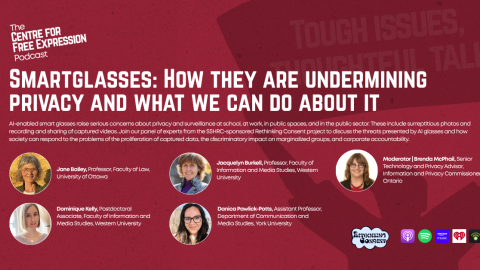
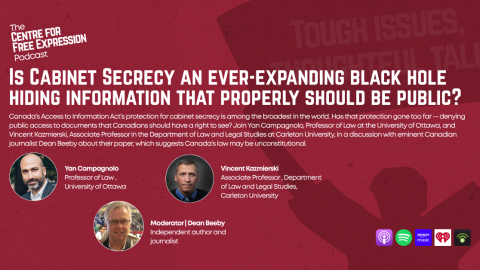
We’re pleased to introduce The Centre for Free Expression Podcast — a thoughtfully edited and produced series that adapts our event recordings into a format designed for listening, and includes additional special conversations.