A blanket smother-up: Alberta government wins secrecy award for opaque access-to-information process
Alberta Premier Danielle Smith’s government has been selected as the provincial winner of the 2025 Code of Silence Award for Outstanding Achievement in Government Secrecy after Alberta’s information and privacy commissioner found the province broke its own freedom of information laws.
The nearly two-year investigation into 27 public bodies was sparked by requests for reviews of access-to-information requests that the province refused, including several made by The Globe and Mail as part of its Secret Canada freedom of information project.
In her May 2025 report, provincial commissioner Diane McLeod found non-compliance by the Government of Alberta included requiring applicants to limit topics in an access request to one, split access requests containing multiple topics, limit the time frame of the search for records to 12 months and structure requests in a way that would allow them to be completed within 30 days.
The commissioner issued several recommendations, including that the provincial government cease non-compliant actions, and that it establish policies and procedures to ensure public bodies are meeting their duties under freedom of information rules.
McLeod said at the time, while the Government of Alberta was planning to replace its Freedom of Information and Protection of Privacy Act (FOIP), the recommendations would still apply to relevant provisions in new legislation that were “the same or substantially similar.”
Alberta replaced its FOIP Act with two new pieces of legislation: the Access to Information Act (ATIA), which came into force in June 2025, and the Protection of Privacy Act, which came into force in December 2025.
Critics have said AITA further limits what information the province may disclose and makes the province’s access-to-information process more difficult and less transparent.
That includes exempting communications between political staff and ministers from disclosure.
“The new exemption for communications between ministers and their political staff drives a gaping hole through the heart of public access legislation in Alberta,” said Phil Tunley, director at Canadian Journalists for Free Expression (CJFE).
“No public officials are more important to the voting public than ministers, and no communications throw more light on their policy choices than those with political staff. This is just a blanket smother-up!”
Also of concern is that AITA extends the timeline for public bodies to respond to access requests from 30 calendar days to 30 business days, and lengthens the appeal process by requiring applicants to first complain to the public body they are seeking records from, rather than allowing them to appeal directly to the Office of the Information and Privacy Commissioner.
While commissioner McLeod has said she was “pleased” with some elements of the new regulations under AITA, she expressed concern that the rules inappropriately reverse the duty to assist onto applicants. She also took issue with a lack of clarity in the regulations to guide public bodies in understanding the breadth of that duty as it relates to helping applicants successfully submit access requests.
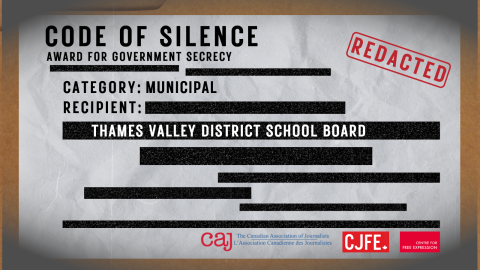
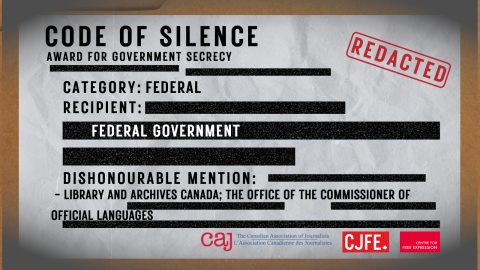
The Code of Silence Awards are presented annually by the Canadian Association of Journalists (CAJ), the Centre for Free Expression (CFE) at Toronto Metropolitan University, and Canadian Journalists for Free Expression (CJFE). The awards call public attention to government or publicly funded agencies that work hard to hide information to which the public has a right to under access-to-information legislation.
The Alberta government previously won the provincial-level award in 2019 for its decision to exempt the Canadian Energy Centre’s internal operations from freedom of information laws.
Last year, Doug Ford's Ontario government was selected as the 2024 winner of the provincial Code of Silence Award for its continued failure to prevent senior employees from using their personal email accounts to also conduct public business.
Nominations for the 2026 Code of Silence Awards will open in September 2026.